

DSO Calculator
What is DSO or Days Sales Outstanding? DSO Simplified
DSO, or Days Sales Outstanding, measures the average number of days a company takes to collect payment after a credit sale. It indicates the efficiency of a company's accounts receivable management and overall cash flow health. When calculating DSO, you won't include sales that are paid at the time of delivery; they wouldn't be considered "credit sales."
DSO is specifically designed to measure the average number of days it takes to collect payment for sales made on credit. The formula for DSO only considers credit sales, accounts receivable, and time.
The DSO measurement quantifies how quickly a business can convert its sales into cash and reflects the effectiveness of its credit and collections processes. A low DSO indicates that a company collects payments promptly; conversely, a high DSO suggests payment delays.
 Why Measure DSO?
 Why Measure DSO?
It depends on who you are and what you're trying to accomplish.
Who is Measuring? 

Accounts Receivable (AR) Teams
The Accounts Receivable (AR) team monitors and collects outstanding invoices and payments from customers. DSO serves as a key metric for evaluating the effectiveness of your collection process. A lower DSO is always better—performance improves when we consistently track what matters. DSO matters because fewer late payments and fewer days between invoicing and payment means better cash flow. Better cash flow reflects positively on you as a credit collections professional.
 Credit Managers
 Credit Managers
Credit managers are responsible for managing a company's credit risk, establishing appropriate customer credit limits, and monitoring the effectiveness of the credit collection department. They track DSO to assess the Accounts Receivable Team's effectiveness and their own performance in managing credit risk. By tracking DSO, they can determine how effectively the AR team collects payments and whether their credit policies support timely payments. Regularly analyzing DSO helps credit managers identify areas for improvement and make strategic adjustments to enhance cash flow.
Finance Departments 

Finance teams oversee an organization’s overall financial management and strategy, including monitoring the performance of credit managers and AR teams. They use DSO as part of financial analysis to understand cash flow and liquidity. They also look at DSO to evaluate the efficiency of credit and collection policies.
 Chief Financial Officer (CFO)
 Chief Financial Officer (CFO)
The Chief Financial Officer (CFO) uses Days Sales Outstanding (DSO) as a critical metric to assess and manage the company’s cash flow, financial health, and operational efficiency, including these areas;
- Cash Flow and Liquidity Management
- Working Capital Optimization
- Evaluating Credit and Collection Policies
- Benchmarking and Performance Assessment
- Financial Planning and Reporting
 Business Analysts
 Business Analysts
The primary role of a business analyst is to identify business problems and propose solutions, ensuring that changes or new implementations align with the company’s objectives. Analysts calculate DSO as part of their assessment of operational performance to see if there are opportunities to lower DSO by optimizing the collections process, tightening credit terms, or identifying high-risk accounts.
Investors and Lenders 

Investors and lenders know DSO is a critical metric in the loan financing process. It is a strong indicator of the business’s cash flow stability and creditworthiness. A finance team will carefully evaluate DSO alongside other financial metrics to ensure the business can meet its loan obligations without risking operational disruptions.
How to Calculate Days Sales Outstanding?
Here are the steps for calculating Days Sales Outstanding;
- Define the period for which you are calculating DSO. Typical choices are 30 days, 90 days, or one year, 365 days.
- Find the total credit sales made during that period. Exclude cash sales.
- Find your total accounts receivable balance.
- Divide your accounts receivable balance by your total credit sales
- Multiply by the number of days in the period you are calculating
Days Sales Outstanding Formula
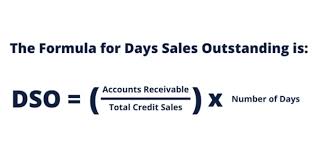 So, Accounts Receivable/Total Credit Sales x Number of Days. Or you can use the handy calculator we've provided here.
DSO Calculation Examples
Example for 90 Day Time Period
Here's a quick example. It's the end of the quarter, and the total sales were $175,000. You check your accounts receivable balance, and it's $47,000. Now divide your accounts receivable balance by your total sales, $47,000 by $175,000. You can also divide 47 by 175, and you'll get the same answer: it's .268 or almost 27% - but I digress - multiply .268 by 90 (the number of days in the quarter) - so .268*90, and you get 24.12, so the amount of time it takes you, on average, to collect an invoice is 24 days.
Example for Calculating on an Annual Basis
Let's say we had those same numbers but for the whole year. We still divide our $47k by our sales for the year, $175k, or 47/175, which is still .268. But now we multiply that by 365, and we get 98 (or use the calculator I provided above), so on average, it's taking you 98 days to collect an invoice.
One More Time - Period 30 Days
Let's do this again. The numbers are the same, but it's monthly. Our credit sales (remember, we disregard cash sales) are $175,000, and at the end of the month, our AR balance is $47,000. We do the same calculation, get the same answer, multiply by 30, and get 25.2, so this month, it took you, on average, 25 days to collect an invoice.
Your Turn
Your sales are still $175k monthly, and your AR is still $47k, but you're calculating the first quarter accounting period, or 90 days—what is your company's DSO?

