
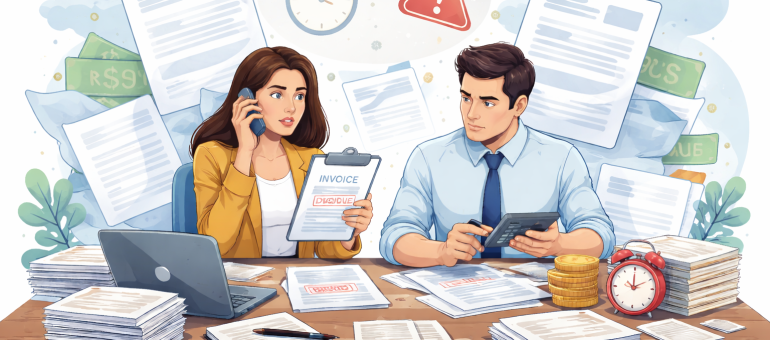
How to Collect Unpaid Invoices: A Practical Guide

How to Collect Unpaid Invoices: A Practical Guide
Late payments are one of the biggest threats to small business cash flow. An outstanding invoice sitting unpaid for 60, 90, or 120 days isn’t just an inconvenience — it’s your money funding someone else’s operations.
The good news is that most unpaid invoices are collectible—if you act systematically and promptly. This guide walks you through a practical AR collection process showing you exactly how to collect unpaid invoices, from the first overdue invoice through escalated collections, so you can recover what you’re owed without burning client relationships and protect your cash flow.
Unpaid Invoices: Why They Happen and What They Cost You
Before you can recover money, it helps to understand why invoices go unpaid in the first place. Common reasons include:
- The client never received the invoice
- Payment terms were unclear
- The client is disputing the work or deliverables
- The client is experiencing their own cash flow problems
- The client routinely uses OPM (other people’s money) to fund operations
- The invoice simply got lost in someone’s inbox
Strong invoicing habits address these issues before they become your problem. Always confirm receipt of every outstanding invoice. Set clear payment terms in writing — Net 15 or Net 30 is standard for most industries. Include as many payment methods as possible, a clear due date, and your late fee policy. When clients know exactly what’s expected and what happens when a past due invoice goes ignored, your on-time payment rate improves dramatically.
Late payments damage cash flow, disrupt financial planning, and kill revenue predictability. For small businesses especially, a handful of overdue invoices can create a cash crisis even when sales are strong. The good news: most unpaid invoices are recoverable if you act systematically and early.
 How to Collect Unpaid Invoices: Your Step-by-Step
 How to Collect Unpaid Invoices: Your Step-by-Step
 Start with Clear Payment Terms
Collection problems often start before the invoice is ever sent. If your payment terms aren’t spelled out clearly — due date, accepted payment methods, late fees, consequences for non-payment — you’ve already given the customer wiggle room.
Every invoice should include the invoice number, invoice amount, balance due, payment due date, and available payment methods. If you offer early payment discounts or payment plans, (not recommended) state them upfront. The clearer the invoice, the fewer excuses a slow payer has.
Send Payment Reminder Emails Before the Due Date
Don’t wait for an invoice to go past due before making contact. A simple reminder three to five days before the due date — personalized with the client’s name, invoice number, amount with an invoice copy, significantly improves on-time payment rates.
Pre-written reminder templates save time here, but a personalized touch goes further with larger accounts. Automated collection tasks can handle the volume for recurring invoices while you focus on the accounts that need a real conversation.
Escalate Systematically on Overdue Invoices
Once an invoice is past due, the clock is running. Here’s a practical escalation sequence:
- Day 7-10 Beyond Terms: Send a friendly status request via email. Keep it simple and include an invoice copy.
- 6 or 7 days after 1st Request: Send a 2nd request – not as friendly but no need to be aggressive either.
- 5 to 7 Days After the 2nd Request: Make a call and send a 3rd Request.
- 3 to 5 Days after the Previous Attempt: Time to get busy. Don’t be overly aggressive, make another call and send another email and consider some of the following options:
- Are you reaching out to the right person?
- Do you have the correct phone number and email? Check with sales for additional contact information.
- Explain the issue to reception and ask who else can help.
- Look for a manager or supervisor.
- Abandon your templated emails and write a more personal inquiry to ap
Handle Customer Disputes Quickly
A disputed invoice stalls payment and, if ignored, becomes a relationship problem. When a customer raises a dispute, get your client-facing team or customer success team involved immediately. Resolve billing questions quickly, dragging out a dispute damages customer relationships and costs more than it’s worth regardless of invoice size.
If the dispute is legitimate, issue a corrected invoice the same day. If it’s not, document your position clearly and escalate.
Document everything. Every email, every call, every promise to pay. If this ends up in small claims court for an unpaid invoice, your paper trail is your case.
How to Collect Past Due Invoices from Customers Who Stop Responding 

When a customer goes silent, your options narrow but don’t disappear.
Flexible payment options can break a stalemate. A customer who’s cash-strapped but not dishonest may respond well to a structured payment plan — timely payments are better than not getting paid at all. Offer it proactively before you escalate further.
Loop in your sales team strategically. If your sales rep has a relationship with the contact, a casual check-in from them sometimes moves a stuck invoice faster than a formal collections notice. Use that relationship carefully, you don’t want to damage a good client over a billing dispute that could have been resolved with a phone call.
What about Alternative Communication Channels?
In today’s digital landscape, alternative communication channels can be more effective for following up overdue and unpaid balances.
Text Messaging
Text messaging is one of the most underused tools in the AR and bad debt collection process. With open rates above 90%, a text gets seen faster than email. A short, professional message referencing the invoice number and balance due — with a direct link to pay — removes every excuse a customer has for not acting immediately.
Texting works especially well as a follow-up to an unanswered email, and for customers who are hard to reach by phone. Keep the tone professional, never threatening, and always include your business name so the recipient knows exactly who is contacting them. For small businesses managing collections without a dedicated AR team, text messaging is a low-effort, high-return addition to any collection strategy.
Social Media as a Collection Tool
Social media has a narrow but legitimate role in the collections process. If you’ve exhausted email, phone, and text with no response, a private direct message on LinkedIn can sometimes reach a contact who has gone dark — particularly with small business owners who are active on the platform. It’s a last-resort touch, not a first move. Used privately and professionally, a LinkedIn Direct Message can break a stalemate when nothing else has worked.
The Pitfalls of Text and Social Media
Both text messaging and social media come with guardrails you need to respect. On the text side, never send messages at odd hours, keep the tone strictly professional, and don’t bombard a customer with repeated texts — that crosses into harassment territory and can expose you to legal liability under the Telephone Consumer Protection Act.
On the social media side, the private DM is acceptable; anything public is not. Posting about a customer’s unpaid invoice on any public feed — regardless of how frustrated you are — opens you up to defamation claims and will damage your reputation far more than the bad debt ever would. Both channels are tools, not weapons. Use them accordingly.
Sending Final Demand Letters and Debt Collection Letters
When your collection efforts have failed, a formal Final Demand puts your customer on notice. Unlike a payment reminder email, a final demand letter documents your collection efforts in writing, states the exact balance due, and gives the customer a clear deadline to pay before further action is taken. The tone is firm and professional — not emotional. A well-written final demand letter often triggers payment from customers who ignored every previous outreach simply because it signals that the next step is a collection agency or legal action.
At Cash In USA, we offer a free final demand letter you can use right now — no purchase necessary. For businesses that need to escalate further, our flat-fee collection letter packages deliver a professional, legally sound collection sequence without the cost of hiring an attorney. If a customer is going to pay without being handed off to collections, a strong final demand letter is often what gets it done.
Additional Best Practices, Do’s and Don’ts for Collecting Unpaid Invoices
In the intricate process of collecting unpaid invoices, adhering to additional best practices can significantly enhance your recovery efforts while preserving client relationships. First and foremost, maintain a consistent follow-up schedule that balances persistence with professionalism. Timely reminders are essential, but ensure they don’t exude impatience; it’s crucial to strike the right tone.
Secondly, consider investing in invoicing software that automates reminders and tracks overdue accounts, this can streamline your process, reduce human error and keep you on track when you get busy.
Alongside these practices, remember the critical do’s and don’ts:
- Do personalize communication to establish rapport, as a friendly approach can often yield results quicker.
- Don’t use aggressive language or tone during follow-ups, as it may alienate clients and lead to further complications.
- Do document all interactions meticulously; a comprehensive record of your collection efforts strengthens your position should legal action become necessary.
By integrating these best practices, you can create a more effective and respectful approach to recovering unpaid invoices.
 When to Use a Collection Agency for Unpaid Invoices

Once an invoice is 120 to 180 days past due, you’re in bad debt recovery territory. The longer you wait to submit the account the less likely an agency will be successful.
Using a collection agency for debt collection takes the burden off your plate and brings professional-grade leverage to the process. This is a good idea when:
- The outstanding balance justifies the cost
- You’ve exhausted your internal collection efforts
- The customer’s payment histories have been consistently poor
- The business relationships are already damaged beyond repair
For smaller balances, small claims court for an unpaid invoice is another path. Filing fees are low, the process is straightforward, and a judgment gives you legal tools to collect — including wage garnishment and bank levies in most states.
Small Claims Court
Depending on your state and the amount due, typically under $10,000, small claims court is an accessible and relatively inexpensive option. You don’t need an attorney so there are no legal fees other than the cost of filing which in most courts is typically under $200. A judgment provides additional legal tools to pursue collection including wage garnishment and bank levies.
Negotiate When It Makes Sense
Sometimes a client genuinely cannot pay the full amount immediately. In those cases, a negotiated payment plan is often better than prolonged pursuit of a lump sum that may never materialize. A structured payment agreement—with the balance, payment schedule, and consequences for default spelled out in writing—gets you back in the payment stream and reduces your exposure.
Before agreeing to a settlement for less than the full amount, weigh the time and cost you’ve already invested in collection against the likelihood of recovering the full balance. There are situations where 70%, received promptly, is a better business outcome than chasing 100% over the next two years.
The Bottom Line
Knowing how to collect unpaid invoices is not about being aggressive or damaging client relationships. It’s about having a clear, consistent process—acting promptly, communicating professionally, and escalating decisively when necessary. The businesses that recover the most on overdue accounts are the ones that treat collections as a system, not a series of uncomfortable one-off conversations.
If your current process isn’t producing results, or if you simply don’t have the time to manage collections effectively, working with an accounts receivable management specialist can recover money you might otherwise write off—and free you to focus on the work that actually grows your business.
Cash In USA specializes in accounts receivable management and collections for small businesses across 40+ industries. Our flat-fee demand letter packages and done-for-you AR collections help businesses accelerate payment and reduce bad debt—without the uncertainty of percentage-based fees.

